
History of Real Tennis
Played by the Greeks and the Romans.
Played with almost religious fervour by medieval clergy.
Taught to generations of French and English kings.
Still played today, with hand-made balls.
From hand-ball to tennis
Scholars tell us that hand-ball (jeu de paume in French) was played by the Greeks and the Romans, and by even earlier civilisations. There are references in the classics to a game that was played in a stone court, as is fives in our country today. Pilare, in Latin, was to play ball and pila was the word for a ball. Hence, palla in Latin and pelote in French. The Roman legionaries, moving into Gaul, perhaps brought the custom of hand-ball with them. What is certain is that the game came to be played in streets against the walls of town buildings and keeps of castles, and in and outside monasteries and ecclesiastical buildings. At a time when England held vast territories in France, the game was not slow to spread to our island. Indeed, the origin of the word tennis is thought to stem from the Anglo-Norman imperative tenetz! The cry of warning given by the server, "Take this! Play!"
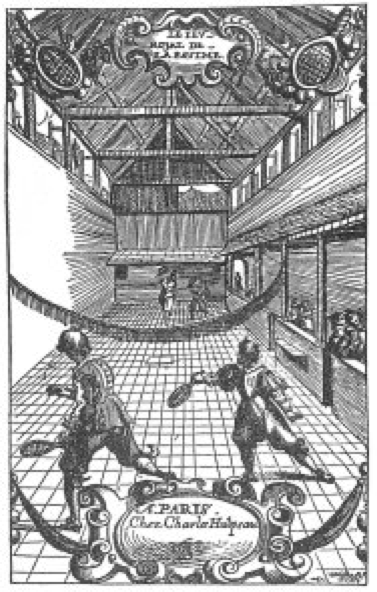
The shape of the court, as we know it today, evolved slowly over the Middle Ages, but by the end of the 15th Century, approximate dimensions had been agreed, an overall length of 90 ft and a breadth of 30 ft. Though tennis is traditionally styled the Game of Kings, early records show that it was the ecclesiastical high-ups who first put their stamp of approval on the game. Prelates, Abbots and minor clergy played it with almost religious fervour. In certain provincial towns in France, the bishop of the diocese received a tithe of tennis balls on Easter Day. With choristers and schoolboys, the sport became a veritable craze and was frequently cited as a cause of truancy. The monastic type of building clearly lent itself to wall games, and it is thought that the eteufs or tennis balls were made from the discarded robes of monks.
During the Middle Ages, players began to protect their hands with a leather glove. Later this glove was to acquire gut strings in the style of a guitar. As this somewhat imperfect instrument evolved, a short six-inch handle came to be added to it. Early drawings depict this battoir and indicate that it was covered with vellum, a practice which led to the stealing of manuscripts by unscrupulous persons. A scholarly performer was once aghast to observe that his hired battoir was covered with still faintly decipherable fragments of a lost decade of Livy.
Five centuries of the game
- 1461
Rules for tennis balls
Louis XI of France introduces an injunction to stop unscrupulous paumiers stuffing balls with dangerous but economic materials such as chalk, sand, ash and sawdust.
- End of the 15th century
The shape of the court is agreed
Approximate dimensions are settled: an overall length of 90 ft and a breadth of 30 ft.
- 1529
Hampton Court Palace
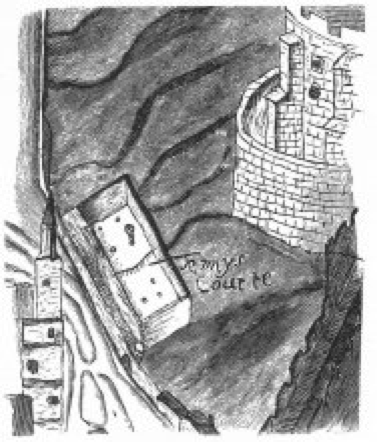
There has been a court at Hampton Court Palace since 1529. Henry VIII was responsible for building the Royal Court there.
- 1539
Falkland Palace
The Royal Tennis Court at Falkland Palace in Scotland, the oldest court in the UK, dates back to 1539.
- 1592
The first published rules
Hulpeau's "Ordonnance du Royal et honourable Jeu de la Paulme" is published in Paris, the first rules of tennis ever published.
- 1668
Pepys at the tennis court
Samuel Pepys's diary entry of 4 April 1668 records a Quaker at the tennis court who swore to himself when he lost.
- 1690s
The current court at Hampton Court
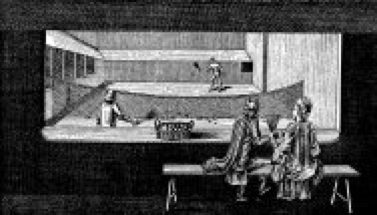
The court at Hampton Court Palace that is played on today is built for William and Mary.
- 1702
Fontainebleau
The court at Fontainebleau, one of the two courts still active in France, dates back to 1702.
- 1767
How a racket is made
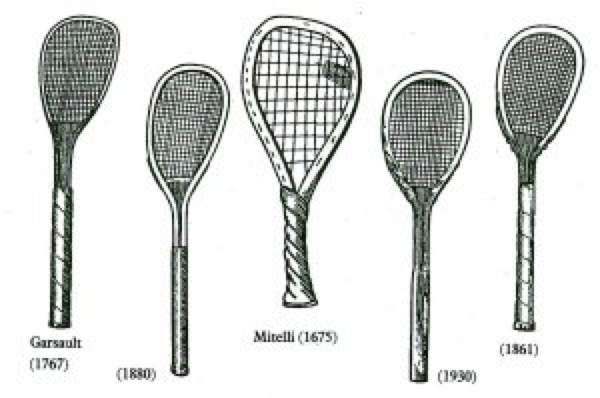
M. de Garsault, an early authority on the game, gives a detailed description of how a racket is made.
- 1977
How to make a Real Tennis Ball
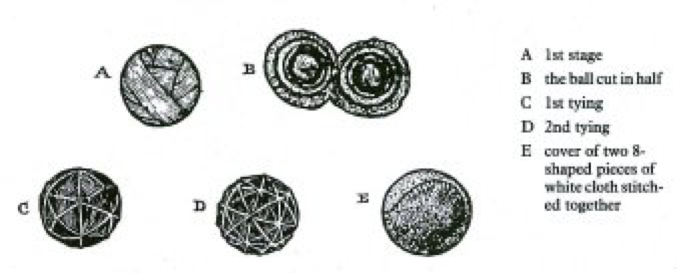
Richard Hamilton writes "How to make a Real Tennis Ball", illustrated by Anthony Hobson, recording the process.
- 2016
The newest court
The newest court in the UK opens at Wellington College.
The Game of Kings
Throughout the history of the game, great stress is laid on its therapeutic value. The Greek doctor Galen recommended it as the most salutary of all exercise. The first rules of tennis ever published, Hulpeau's "Ordonnance du Royal et honourable Jeu de la Paulme, Paris, 1592", began "You gentlemen who desire to strive with another at tennis must play for the recreation of the body and the delectation of the mind, and must not indulge in swearing or in blasphemy against the name of God". Pepys, in a diary entry of April 4th, 1668, writes, "How my Lord of Pembroke says he hath heard the Quaker at the tennis-court swear to himself when he loses".
It is hardly surprising that generations of French and English kings were taught the game in their youth. Charles II of France was painted with a racket in his hand at the age of two. The commoner was only too anxious to try his hand at the Game of Kings, and repressive measures, for the most part ineffective, were enacted in both France and England in order to restrict the game to nobility only. Henri II was the star of all the French kings, though the much loved Henri IV was the greater zealot. In England, James I's son, Henry, who sadly died at eighteen, was reputed to have been a brilliant performer. The English royalty played in courts at Windsor, Whitehall, Westminster, Wycombe and Woodstock.
It is well known that in Shakespeare's Henry V, the hero, having been insulted by the Dauphin with a gift of tennis-balls, threatens to "Strike his father's crown into the hazard" warning him that "he hath made a match with such a wrangler that all the courts of France will be disturbed with chases". Henry VII and Henry VIII were both keen supporters and excellent performers, the latter being responsible for the building of the Royal Court at Hampton Court Palace. Charles I and Charles II were devotees of the game all their lives and both used to rise at five or six in the morning to play. Pepys, after a visit to the new tennis court at Whitehall, wrote of Charles II, "But to see how the king's play was extolled, without any cause was a loathsome sight, though sometimes he did play very well and deserved to be commended, but such open flattery is beastly". It is known that his brother, James II, was also a fine player (surely one of his few redeeming features!) and there is also a well-known portrait of him playing as a boy with a short-handled racket before a crowd of ladies and gentlemen in the dedans. His son-in-law, William III, played from time to time, fortified, we are told, with stoups of Spanish wine. The untimely death of Frederick, Prince of Wales in 1751 was due, according to that inveterate gossip, Horace Walpole, to a "blow upon the stomach from a tennis-ball": one of a number of royal casualties resulting from tennis.
The history of tennis rackets
M. de Garsault, an early authority on the game, gives a detailed description in 1767 of how a racket was made. Specially selected ash rods were boiled to make them flexible and then bent in half, so that the resulting loop became the embryo racket-head and the long ends, bound together, became the handle. A seventeen-inch-long centre piece of soft wood was inserted between these ends and strengthened with the fibre of tendons taken from between the hock and hind hoof of an ox, and glued over with parchment. A tilt was then imparted to the head of the racket making it "pear shaped" with the aid of a special clamp, and it is this weighting of the head of the racket that helps a player apply the cut stroke more effectively.
The effect of a cut shot is to make the ball "die" when it bounces off the back wall. A lawn tennis player's top spin shot is not ideal in real tennis as the ball sits up after hitting the back wall and gives the opponent more time to get into position and play a decisive shot.
The racket frame was pierced with holes and strung with sheep gut, vertically and horizontally. Nowadays, the racket strings are made of synthetic material and handles and frames are reinforced with a plastic coating. Attempts were made in the 1990s to introduce metal rackets but these were banned, mainly for fear of the damage they might cause to court floors and walls.
Rackets have been made for many years by Grays of Cambridge. There are four types: junior, standard and the reinforced semi-tec and extra-tec.
The history of tennis balls
A real tennis ball is made by hand. As yet no synthetic version has been invented that performs acceptably on a court. The methods have changed little over the years. At the centre of the ball there is a hard kernel, originally a compacted sphere of ball cloth and nowadays a round cork, which is then covered layer on layer with about ten metres of tape. This is hammered into shape in a special metal or wooden cup, then tied with thin strong string, criss-crossed and knotted once or twice. The tying is the difficult part of the operation and was originally carried out with a special instrument called a bilboquet. The tied ball is covered with two sections of yellow cloth, each cut in the shape of an eight and tightly stitched round it.
The earliest balls, known as eteufs, were made from dog-skin and stuffed with bran.
A full set of balls was traditionally 108 but at Moreton Morrell a half set of 54 balls is re-covered every week. If the string holding the ball together has slackened, the ball will have to be re-tied. All kinds of things were used to produce the inner portion of a tennis ball. A quotation from Much Ado about Nothing implies that in Shakespeare's day, tennis balls were stuffed with human hair, for Claudio says of Benedick, "The old ornament of his cheek hath already stuffed tennis balls". An injunction was introduced by Louis XI of France in 1461 to prevent unscrupulous paumiers from using dangerous but for them economic materials for stuffing, such as chalk, sand, ash and sawdust.
I freely admit to being biased but maintain after every tournament held at Moreton Morrell that the balls made by the professionals here are as good as any in the world. May they long continue to justify such an accolade!
Richard Hamilton, from his booklet "How to make a Real Tennis Ball", illustrated by Anthony Hobson, 1977
Try the Game of Kings
Book a lesson with one of our professionals.