
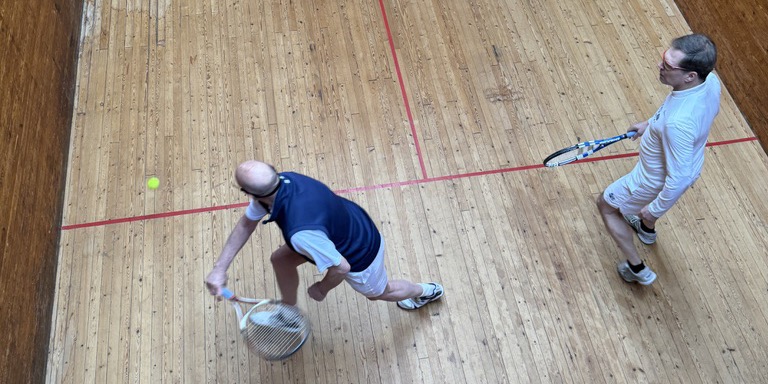
Squash Tennis
On the only purpose-built court still in play in the world.
An American game, kept alive in Warwickshire
Squash tennis is an American variant of squash that was popular in the USA from the end of the 19th century up to the Second World War, since when the game has died out as squash and racquetball have grown in popularity.
Moreton Morrell is proud to have the only court that we know of built outside of the USA, and the only court in the world we believe still in regular play.
Squash tennis is played with lawn tennis balls and short-handled lawn tennis rackets that create a fast and complex game.
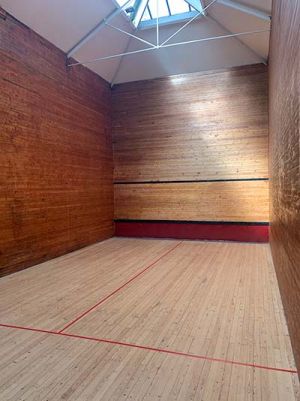
The squash tennis court is similar in size to a squash court but slightly narrower. The Moreton court is 16'6" wide and 31'6" long. One feature of the squash tennis court is the low back wall, with the outline at only 4'6" high. Another distinguishing feature is the centre line that runs from the service line to the front wall, unlike a squash or rackets court which divides the area between the service line and the rear wall. This reflects the squash tennis serve, which mimics lawn tennis in requiring the serve to land in the front quadrant.
How to play
Serving
The players determine who serves first by spinning a racket. When the server loses a point the serve passes to the opposing player. The player that wins a game serves first at the start of the next game. When starting a set of serves the server may choose which side of the court to serve from first, with serves then alternating from side to side with each point.
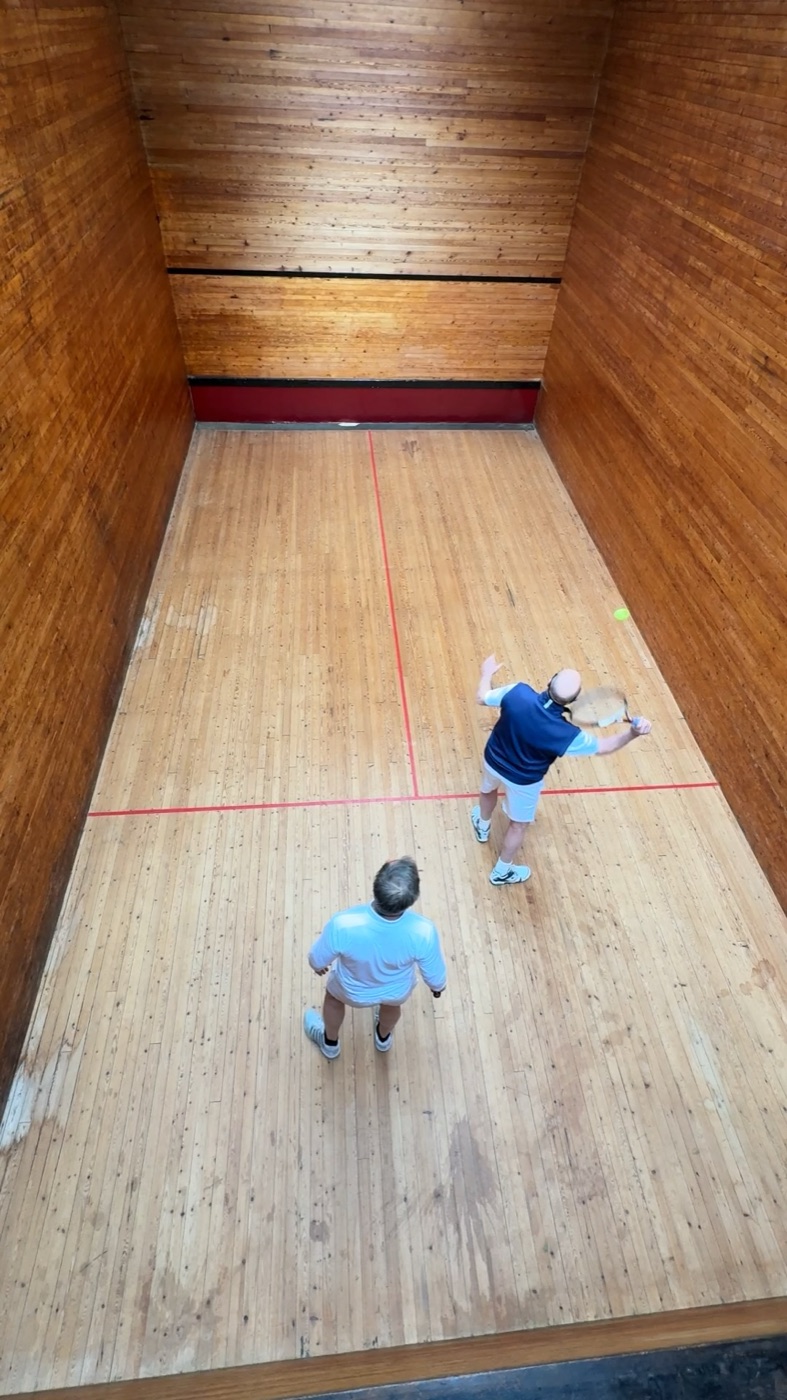
The serve must hit the front wall first above the service line and, without hitting the back wall, the ball must land on the floor in front of the service line on the opposite side of the court. The ball may hit the side walls after hitting the front wall. In serving to the front quadrant squash tennis is like tennis, and differs from squash where the serve is to the rear quadrant. If a serve is not a valid serve it is a fault, and if it is the first fault the server must serve again from the same side. If the server makes two consecutive faults they lose the point.
Pictured: Gary Squires, the last squash tennis world champion, serving at Moreton Morrell in 2025.
Rallies
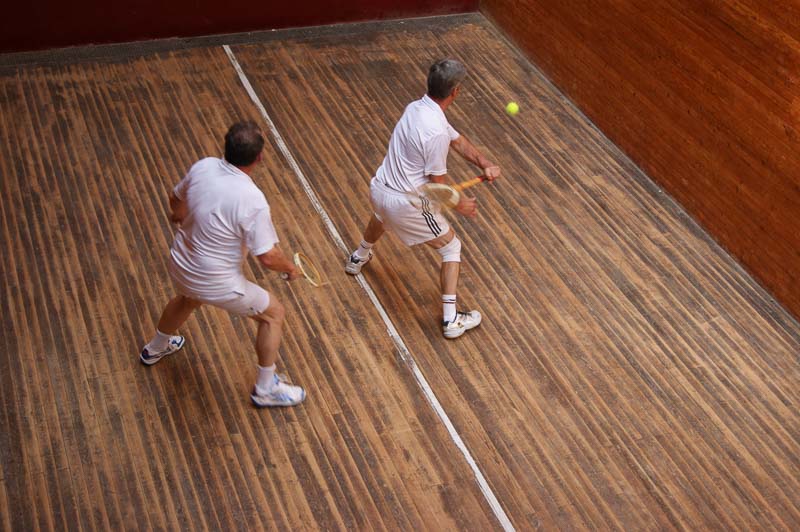
A serve may only be returned after it has bounced once and before the second bounce.
The receiver must return the ball before it bounces for a second time. The ball must directly or indirectly hit the front wall without going out of bounds or striking the tin.
The players then alternately strike the ball in the same manner, except that it may also be volleyed, until one player fails to make a fair return. The player failing to make the fair return loses the point.
- If the ball strikes the lights or ceiling it is out of bounds.
- If the ball strikes the back wall above the 4'6" line without bouncing it is out of bounds.
- If the ball strikes the back wall above the 4'6" line after it has bounced it is still in play.
- If the ball, having bounced, goes into the gallery or hits an obstruction that alters its course, a let is called.
Scoring
The winner of a game is the first to reach fifteen points, except when both players tie at thirteen all or fourteen all.
At thirteen all, the first player to reach thirteen chooses to play to 18 ("set five"), 16 ("set three") or 15 ("no set").
At fourteen all, providing the game has not been thirteen all, the player first reaching fourteen may choose to play to 17 ("set three") or 15 ("no set").
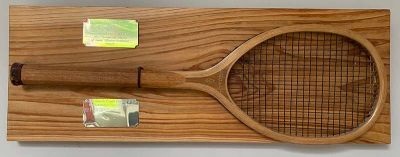
Pictured: a squash tennis racket from about 1920. Its plaque reads: "Squash Tennis Racquet c1920. Presented in 2001 to MMTCC by Mrs Jeanne M Cherry of Santa Monica California".
Try squash tennis
If you would like to play squash tennis, please contact the club. We really like keeping this game alive.
The history of squash tennis
Squash tennis is one of a handful of sports that were first played in the United States of America. It comes out of the games of rackets and squash.
The game was first played at St Paul's School in Concord, New Hampshire in the early 1880s. School master James P Conover, who is also credited with introducing ice hockey to the USA, had played rackets while studying at Columbia and at the Montreal Racket Club. In 1883 he had two rackets courts constructed at the school and he ordered rackets and balls to be imported from Arthur Pearson in London, but these were detained for several months at the Customs House in New York. Eager to use the new courts, the boys started playing with rackets and balls from the new and fashionable game of lawn tennis, giving birth to a version of tennis played in a court against a wall. Once the rackets equipment arrived the boys quickly took to the traditional game but also continued with their own variant. The school added four smaller open-air squash rackets courts to the building in 1884 and these proved more suited to the squash tennis game.
The St Paul's courts were the first squash courts to be built in North America and followed the dimensions of those at Harrow School in England. Conover felt that squash rackets was a safer option for the boys to play, having a softer ball which led to fewer injuries than with rackets. He may well have encouraged the playing of squash tennis along with other innovations within these racket sports; the school is also responsible for the differences between American hardball squash and the international soft ball version. The soft rubber squash ball did not fare well in the freezing winter temperatures of these courts, remaining slow and sluggish, which led to the development of the harder American squash ball and consequently the more suitable narrower (18.5 ft) courts that were a feature of American squash until the end of the 20th Century, when the international standard softer ball and wider court (21 ft) became more widely adopted.
The fast rallies and lively action of squash tennis meant that it remained popular with the boys at school and they took it with them when they moved on. The Boston Athletic Association's new clubhouse built in 1888 featured a Rugby Fives court that soon became the home for their game of choice, squash tennis.
Very soon new courts were being built on private estates and country clubs across New England and wider afield. Specialist squash tennis rackets that were lighter and shorter than their lawn tennis counterparts were developed, and a fast inflated webbed ball was adopted that zipped around the growing number of courts.
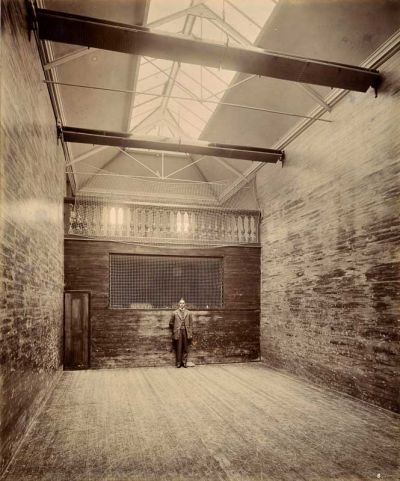
At this time our wealthy American founder Charles Tuller Garland built the Moreton Morrell tennis court and along with it our squash tennis court, the only one that we know of in "old" England.
In 1911 the (US) National Squash Tennis Association was founded, a standard court size was adopted (17 ft x 32.5 ft) and an inter-club league started the following year. Squash tennis was more popular in America at this time than squash racquets because of the pace and action that it provided.
The game's peak popularity came between the wars as players strove for more speed and adopted a more highly pressurised ball. But this in turn made it difficult for new players to learn and compete with experienced players, discouraging many from taking up the sport. The Second World War also brought rubber shortages which brought an end to the webbed ball, and the game all but died out. At the same time squash racquets flourished.
After the war the game returned to its roots and adopted the lawn tennis ball, which made it easier to play but disenchanted the old players who remembered the faster game. Attempts were made to revive the game throughout the 50s and 60s and new balls created, but with increasing competition from the new sport of racquetball, squash tennis dwindled. Occasionally players in some of the older American clubs will play the game on the slightly wider American squash courts where they remain, or even on the wider still international courts, but the preference is for the narrower courts that are now limited in number. The last US National Championship was contested in 1995 and the NSTA no longer meets, meaning the game is now virtually extinct.
There is a purpose-built squash tennis court still in playable condition in America at Plum Orchard that was restored in 2008. Originally built in 1903/4, the court is part of George Lauder Carnegie's estate on Cumberland Island, Georgia, now part of the National Park Service.
The court at Moreton Morrell remains open for play, which we think makes it the last court in the world. We play with short-handled modern lawn tennis rackets and lawn tennis balls.